Tuesday, June 11, 2013

Sharing Published Books in the ECP

Today was an exciting day in the Early Childhood classroom!  The young authors and illustrators in Mrs. McLean's ECP class shared their published books with the staff members at Blanchard!                                          
                          
                                   Mrs. Barnett - "I enjoyed the colorful illustrations.  Their creativity was impressive! The children were so excited about sharing their books."

Mr. Bates- "I was so impressed with the students' ability to read their Love Books.  I enjoyed learning all the special information about each of the authors.  It is always a joy to take time to visit in the ECP.  It makes me remember all the important aspects of student learning."

Mr. Ralls, our head custodian, stopped by to listen to our books and to enjoy a few snacks as well.  The children served fruit, homemade banana bread and lemonade.  Taking complete ownership of their special day, they planned the menu and designed the invitations on our laptop.


Mrs. Tremblay, "It was so exiting to see the children's eyes as they shared their personal publications. The pride that they took in themselves as authors and illustrators shined brightly in their smiles!"

Mrs. Mannherz- "Love is seeing the face of a child reading her first published book ...so proud!"


Mrs. Kilcommins- "You're serving my favorite drink and lemon snacks!"  Sahithi, "Me too!"
                                The children did a fabulous job hosting their event.

 THE CHILD IN THE COMMUNITY

"As the circle of a child's experience expands from family to school to community, so does awareness of self and others."

Activities outside the family, such as play dates and preschool, broaden children's horizons and widen their social, emotional, physical and cognitive growth.  "Excursions to the playground, library or fire station offer new and exciting opportunities as well as challenges.  Feelings of attachment to a neighborhood, community or local landscape develop.  Whether new or familiar, communities can be places that nurture cultural identity, diversity, responsibility, adventure, and a sense of belonging." (Eric Carle Museum staff)  When children create relationships with places and people in their community, this involvement begins to build the foundation for citizenship and social responsibility.  

     WHAT INSPIRED US TO WRITE BOOKS ABOUT THE THINGS WE LOVE?

Throughout this school year, the children in the Early Childhood Program were immersed in studies about friendships, maps, our community and the things we love.  In the beginning of our investigations, we worked hard at defining what it means to be a good friend.  Our am and pm classes created a "Friendship Tree" with Mrs. Kilcommins' Kindergarten class.  Our friends also became very interested in exploring our outdoor environment surrounding our school by going on several nature hikes and by researching important information on Google Earth using our new classroom Ipad (A special Thank you to PTF!).  We designed 3-dimensional maps to deepen our knowledge and understandings of our community. We also made predictions about what we might discover before venturing outdoors.  Some of our predictions included, "a beaver dam", "a library", "curvy trees" and "maybe a dump across the street!” As we explored the great outdoors with our "thinking pens" and sketchbooks in hand, we discovered that the fire station is across the street not the dump!  These are just a few of the investigations that inspired our thinking for these wonderful books.

Collectively, we also published a class book.  The children loved brainstorming ideas, listening to each other, presenting their work at "share chair" and creating their illustrations at our writing studio.  This documentation demonstrates, values, and celebrates a large range of developmental learning stages in a multi-age, Early Childhood classroom. This experience taught our children that they are valued thinkers, writers and illustrators.  The entire process also fostered a sense of belonging to our school family and the larger community. This book will soon be available for you to enjoy at our school library and at the Sargent Memorial Library.  

                              Wishing everyone a fun and safe summer vacation!  Happy reading!!
                                                                                                                        
Mrs. McLean's Early Childhood Program 
June 2013
 

Friday, June 7, 2013

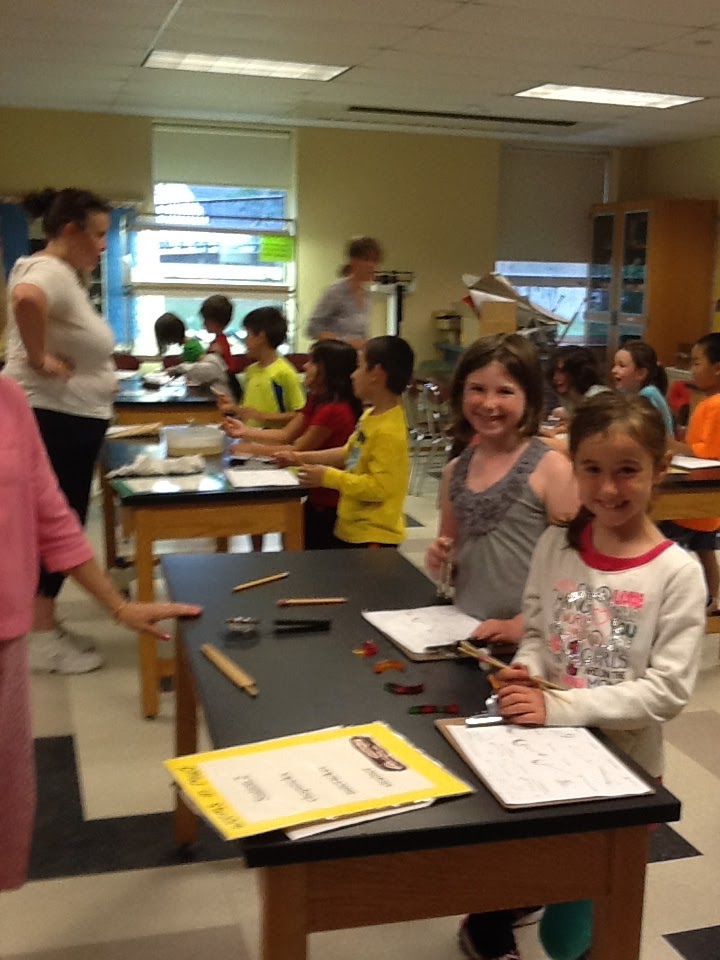
First Grade Students Investigate How Birds Eat in Science Lab

The first grade students investigated how birds eat today.  We have pictures from Mrs. Neuman's and Mrs. Geran's class.  On Field Day, we will post more pictures from Mrs. Flannery's class!

From Mrs. Neuman's Class, the students write, "We learned birds have different sized shape beaks for eating different foods.  A toucan has a big tong-like beak for eating fruit."

Here are some pictures from the science lab:


Wednesday, June 5, 2013

Summer Learning Resources
Summer is the perfect time for students to relax, recharge, and have fun. It's also a time when students regress academically. Fortunately, access to the Internet can help provide students with engaging and effective resources to stem summer learning loss. Blanchard Memorial School students can use a variety of educational websites to practice math and literacy skills. Please check the Blanchard parent wiki at http://techschoolbus.wikispaces.com/Summer+Learning for more information about how to access our school’s instructional technology accounts and other resources.  
Peggy Harvey, Instructional Technology Specialist
pharvey@boxboroughschool.org

Friday, May 31, 2013

Fourth Grade Investigates Force and Motion by Justine A., Leimalia T., and Lindsay R.

Today, we had a Museum of Science presentation.  The performance was all about simple machines, force, and motion.  We learned the 6 functions of work.  Thank you PTF for making this possible!  


Tuesday, May 21, 2013

Lacrosse in P.E.


Lacrosse is one of my all-time favorite P.E. units.  While the sport continues to experience major growth throughout the state, it is still very new to many of the elementary school students.  I find that the students that are new to lacrosse are eager to learn the sport.  Fortunately, we were able order brand new lacrosse sticks for this spring.  The sticks that we use in class are smaller versions of the actual sticks used in league play.   
This is a sport that can be frustrating when you first attempt some of the skills.  With that being said, I take the time to discuss this with the students before we begin our unit.  We talk about the importance of trying our best, continuing to practice, and not giving up.  As in all units, effort is the key, and if students aren’t putting the effort in, the skills become much harder to master. 
            We briefly cover the history of the game, and all students are notified of the safety rules associated with handling the stick.  In lacrosse, it is important to remember to keep two hands on the stick, so the students are showed how to properly handle their stick around others.  All students have done an excellent job of taking care of their stick during the course of this unit. 
            In many classes, there is a student or two that either plays on a team, or has had some experience with lacrosse in the past.  I talk to these students at the beginning of the unit of how cool it would be for them to help their classmates learn the skills.  I call them my “teacher’s assistants”, and it is amazing to see how well the students interact with each other as they practice.  I have seen some really nice things during the past couple of weeks with students helping each other out.  It is a real self-esteem booster for both students that know the game, and students that are new to lacrosse.
            There is no checking allowed with the stick or body, and the P.E. version is called “soft lacrosse”.  We focus on the basic skills that will allow us to gain an understanding of how the game is played.  The skills that we work on include: Catching, Throwing, Cradling, Scooping, Shooting, and Defending.  Students in the younger grades focus a lot on spacing and the handling of the stick.  Each class in grades K-6 participates in drills and games that help develop these skills. 

Friday, May 17, 2013


Counselor’s Corner


As We Approach the End of the School Year…


Christine Garcia, C.A.G.S., LMHC, NCSP

Blanchard School Psychologist


          It is hard to believe it is already May!  The birds are chirping, the flowers are blooming, and the grass is getting greener with every passing day.  Many of us are enjoying the great outdoors…watching our kids play on the playground or participate in sports, barbequing with family and friends, bike riding, gardening, and anticipating that first hot, sunny day in June that marks the beginning of New England’s most laid back season.  It is a wonderful time of year and one that many look forward to after being inside all winter.  However, for some, this spring will not bring all the joy and happiness that many of us experience.  This spring, New England is a bit more subdued.  For this spring, the area we all love will be reflecting on the losses that have been incurred over the past four months.

 
          The tragedy of Sandy Hook is still burning in people’s minds, as they try to make sense of how it was possible that so many elementary school children and beloved staff lost their lives on December 14, 2012.  This particularly hit home to our small school, as the air view of Sandy Hook could have easily been mistaken for the Blanchard School.  Then, on Monday, April 15, 2013 tragedy struck again…a bombing occurred at the Boston Marathon, again taking the lives of three innocent people while injuring many others.  And if that was not bad enough, more fear was instilled, as the suspects went on the run, killing more and putting our great city in lockdown.  While cheers were heard from miles away when the final suspect was caught, more information continues to come out about the bombings, as we are privy to it everyday through our media.  When we stop and reflect on the last four months in our area of this country alone, then add on a lagging economy and high-achieving atmosphere, it is no wonder why schools are seeing a significant increase in mental health crises among students.  So where does that leave us?  How do we, the parents and teachers of these young children…children who are trying to make sense of so much that is nonsensical… help them? That is the question we are all trying to answer.

 
          As the School Psychologist at Blanchard who solely deals with completing psychological evaluations, I have been astounded by the increase in mental health referrals this school year.  At this level, such difficulties have presented first as struggles with executive functioning, which refers to a set of cognitive abilities that control and regulate other behaviors (i.e., planning, problem-solving, rule following, flexibility).  This means that children who have problems following directions with multiple steps are likely to become frustrated and anxious, which ultimately may impact not only their school work, but their interactions with others.  In more severe cases, aggressive behavior, insubordination, school phobia, peer ridiculing, and depressive symptomology have been noted.  What is crucial to keep in mind is that often times, these behaviors appear in the school setting first before ever reaching home. 
 
      As a school system and as parents, we have all worked hard to ensure the safety of all of our students.  Nonetheless, the demand for high achievement, along with social acceptance, continues to thrive.  In addition, many of our students feel over scheduled and long for a chance to just to take a break and breath.  This brings us back to the essential question…how can we help our children?


The first and most pertinent way to help your youngster is to be honest with them.  Our school varies in age and thus, you must keep in mind the cognitive level in which your child can process information.  For example, a kindergarten student can not handle the details in which a sixth grader can.  Nonetheless, they are all in an environment, be it home through media or school with other children, in which tragedies are openly discussed.  The obvious solution for parents is to talk to their child first and then limit as much media exposure as possible when tragedies do occur.

 
          Second, if you notice your child does not appear to be themselves, sit down and talk with your child to see if anything may be happening in their world in which they are feeling anxious, stressed, and/or overwhelmed.  We as parents often underestimate how important it is to give our children our full attention for 5-10 minutes out of the day.  This can be as simple as talking to them in the car, at bedtime, or during meals.  You will be surprised at how much your children will share with you if they feel you are listening.  If that doesn’t work, journal writing between you and your child can often be an extremely effective mode in learning your child’s feelings.

 Finally, as parents and educational professionals, we often times want to rush in and ‘fix things’ for our children.  We have become a ‘helicopter’ society.  A society that does not encourage individualism, creativity, or the acceptance of mistakes that allows for learning.  By ‘doing’ for our children in so many ways, we are setting them up for failure as adults.….adults who won’t understand how to make a mistake without self-criticism; adults who will expect things to be given to them instead of working hard for them; or adults who can’t find jobs because their creativity was stunted by too much help from the people who cared the most about them. 


To end, the best thing we can do for our children is allow them to feel the ‘social growing pains’ of life.  Help them learn coping skills to deal when faced with lives adversities.  Help them feel confident through listening to them and encouraging them to believe in their ideas…to lead and not follow.  Tell them that it is absolutely normal to feel angry and sad at times, but it’s what they do with those feelings that count.  Teach them to live in the moment…..smell the flowers, look at the trees blooming, listen to rain, looks at the colors in the sky, and enjoy their snow day, even if it is an imposition to us.  An old friend once said to me, “The past is history; the future is a mystery; now is a gift, that is why it is called the present.”  Enjoy each day with your children to the fullest.  Be present in their lives and listen to them.  For many of those who have lost loved ones this year, that is not possible.  What they wouldn’t do to be in your shoes again.


Note:  Please consult with a professional should you or others around you notice a dramatic change in your child’s social/emotional functioning.  If you are unsure of who to call, please contact the School Psychologist, Guidance Counselor or your pediatrician for support and resources.

May 2013

Library News
                                                                        by C. LOng
 

What have our students been learning this spring?


6th graders:

Students in sixth grade have been learning about digital citizenship and internet safety.  They created projects in VoiceThread and Prezi to demonstrate their understanding and to learn new presentation tools.  Creating a project in iMovie is next.


5th graders:

Students have been studying Westward Expansion; they completed their four paragraph essays which they typed in MS Word.  New technology skills they acquired include: adding and citing images, adding text boxes and footers, using spell check, and various formatting tools.  


4th graders:

Fourth graders have been researching and creating projects in PowerPoint about Canada and its provinces.  Students have honed their presentation skills with PowerPoint. A study of Mexico is coming up. 


3rd graders:

A third grade project this spring addressed social studies and technology standards.  Students used both book and online encyclopedias to research famous Baystaters and used the software, Timeliner, to show what they learned.  Next students will research the flora and fauna in the habitat behind our school.


2nd Grade

Each student was assigned a different country and used non-fiction books to learn about what came from that country that we have here in the U.S.  Students presented the posters they created.  The project addressed many learning standards including Social Studies, Information Literacy, and English Language Arts. 


1st Grade

First graders learned about the national symbols.  The unit reinforced Social Studies standards and English Language Art (parts of a non-fiction book). 


Kindergarten

Using the software program, Kid Pix, students wrote a rhyming sentence and drew a picture about their favorite place to read. Students have enjoyed some classic read-alouds and coming up, each class will use Kid Pix to create a class alphabet book.

                                                  
This spring we have been celebrating literacy with reading incentive programs and a community read aloud.  There have been reading incentive programs for both the lower and upper grades.  The lower grades logged over 1000 hours of reading during our “Apples Up on Top” challenge.  Many of our upper grade students are reading 5 or more books from a special collection in the Library.  Some have created their own goal of reading 10+ books!  New this year, 5th and 6th graders are enthusiastically blogging their book reviews. 


All books will be due back in the library by Friday, May 31.

Exceptions will be made for special circumstances, for example if a student needs a book to complete a project.  Library classes will continue, students will finish projects and participate in activities that review library skills that they have learned throughout the year.  Librarians from the Sargent Memorial Library will be visiting library classes in June to talk about the public library’s summer reading program.